IPCC Methodology Tiers in cowfootR
Source:vignettes/03 - IPCC Methodology Tiers cowfootR.Rmd
03 - IPCC Methodology Tiers cowfootR.RmdUnderstanding IPCC Methodology Tiers
The Intergovernmental Panel on Climate Change (IPCC) provides three tiers of methodological complexity for greenhouse gas inventory calculations. cowfootR implements Tier 1 and Tier 2 methodologies for dairy farm carbon footprint assessments. This vignette explains the differences, when to use each approach, and demonstrates their practical application.
Data Requirements Analysis
Tier 1 Data Needs
tier1_requirements <- data.frame(
  Category = c("Animal Data", "Production", "Management", "Optional"),
  Essential_Data = c(
    "Number by category (cows, heifers, calves)",
    "Annual milk production (litres)",
    "Manure system type, basic inputs",
    "Farm area, country location"
  ),
  Time_to_Collect = c("< 1 hour", "< 1 hour", "1-2 hours", "< 1 hour"),
  Data_Source = c("Farm records", "Milk processor", "Farmer interview", "Farm records")
)

kable(tier1_requirements, caption = "Tier 1 Data Requirements")| Category | Essential_Data | Time_to_Collect | Data_Source |
|---|---|---|---|
| Animal Data | Number by category (cows, heifers, calves) | < 1 hour | Farm records |
| Production | Annual milk production (litres) | < 1 hour | Milk processor |
| Management | Manure system type, basic inputs | 1-2 hours | Farmer interview |
| Optional | Farm area, country location | < 1 hour | Farm records |
Tier 2 Additional Requirements
tier2_additional <- data.frame(
  Category = c("Animal Characteristics", "Nutrition", "Management Detail", "Environmental"),
  Additional_Data = c(
    "Body weights, milk yield per cow, breeding records",
    "Feed composition, DM intake, diet digestibility",
    "Precise input quantities, equipment usage",
    "Climate data, soil types, system temperatures"
  ),
  Time_to_Collect = c("2-4 hours", "4-8 hours", "2-4 hours", "1-2 hours"),
  Expertise_Level = c("Basic", "Intermediate", "Basic", "Basic")
)

kable(tier2_additional, caption = "Additional Tier 2 Data Requirements")| Category | Additional_Data | Time_to_Collect | Expertise_Level |
|---|---|---|---|
| Animal Characteristics | Body weights, milk yield per cow, breeding records | 2-4 hours | Basic |
| Nutrition | Feed composition, DM intake, diet digestibility | 4-8 hours | Intermediate |
| Management Detail | Precise input quantities, equipment usage | 2-4 hours | Basic |
| Environmental | Climate data, soil types, system temperatures | 1-2 hours | Basic |
Input columns used by calc_batch() for Tier 2
calculations
When using calc_batch() with tier = 2,
users may provide additional farm-level variables to enable more
detailed IPCC Tier 2 calculations. All inputs represent one accounting
year unless explicitly stated otherwise by the column name (e.g.,
*_kg_day).
The input data frame is flexible: only a small set of columns is strictly required, while the presence of additional columns enables more refined calculations. Missing optional columns do not cause errors; instead, cowfootR falls back to Tier 1–consistent default assumptions following IPCC and IDF guidance.
Core required columns (all tiers)
-
FarmID: Unique farm identifier
-
Milk_litres: Annual milk production (litres/year)
-
Cows_milking: Number of milking cows
-
Area_total_ha: Total managed farm area (hectares)
Tier 2–relevant optional columns by emission source
Enteric fermentation (Tier 2 refinement)
Providing one or more of the following columns enables Tier 2 enteric methane calculations based on animal performance and intake:
-
Milk_yield_kg_cow_year: Average annual milk yield per cow (kg/year) -
Body_weight_cows_kg: Average body weight of milking cows (kg) -
MS_intake_cows_milking_kg_day: Dry matter intake of milking cows (kg/day) -
Ym_percent: Methane conversion factor (% of gross energy intake)
If none of these variables are provided, Tier 1 default emission factors are used.
Young stock (optional refinement)
When young stock is included, Tier 2 calculations may also use:
Body_weight_heifers_kgBody_weight_calves_kgBody_weight_bulls_kgMS_intake_heifers_kg_dayMS_intake_calves_kg_dayMS_intake_bulls_kg_day
Manure management (Tier 2 refinement)
Tier 2 manure emissions may use additional information when available:
-
Manure_system: Manure management system (e.g., pasture, liquid storage) -
Diet_digestibility: Diet digestibility (fraction) -
Protein_intake_kg_day: Average protein intake per animal (kg/day) -
Retention_days: Manure storage or retention time (days) -
System_temperature: Average system temperature (°C) -
Climate_zone: Climatic classification used for emission factors
Theoretical Background
IPCC Tier System Overview
The IPCC tier system balances accuracy with data requirements and complexity:
- Tier 1: Default emission factors with basic activity data
-
Tier 2: Country/region-specific factors with
detailed activity data
- Tier 3: Advanced modeling with comprehensive measurements (not implemented in cowfootR)
Key Differences in Dairy Applications
| Aspect | Tier 1 | Tier 2 |
|---|---|---|
| Emission Factors | IPCC default values | Region/farm-specific values |
| Data Requirements | Basic (animal numbers, production) | Detailed (weights, intake, composition) |
| Expected precision | Lower (screening-level) | Higher (farm-specific when good data are available) |
| Time Investment | Low (hours) | Medium (days) |
| Suitable For | Screening, regional estimates | Farm management, policy |
## Methodological Differences by Emission Source
### Enteric Fermentation
#### Tier 1 Approach - Uses fixed emission factors by animal category and production system - Based on broad regional averages - No consideration of diet quality or animal performance
# Tier 1 enteric calculation example
enteric_tier1 <- calc_emissions_enteric(
  n_animals = 100,
  cattle_category = "dairy_cows",
  production_system = "mixed",
  tier = 1 # Uses default emission factors
)

print(enteric_tier1$emission_factors)
#> $emission_factor_ch4
#> [1] 115
#>
#> $ym_percent
#> [1] 6.5
#>
#> $gwp_ch4
#> [1] 27.2
#>
#> $method_used
#> [1] "Tier 1"
Tier 2 Approach
- Calculates methane based on energy intake and conversion efficiency
- Accounts for diet digestibility, animal productivity, and body weight
- Uses farm-specific or regional Ym (methane conversion) factors
# Tier 2 enteric calculation with detailed parameters
enteric_tier2 <- calc_emissions_enteric(
  n_animals = 100,
  cattle_category = "dairy_cows",
  avg_milk_yield = 7200,
  avg_body_weight = 580,
  dry_matter_intake = 19.5,
  ym_percent = 6.2,
  tier = 2 # Uses energy-based calculation
)

print(enteric_tier2$emission_factors)
#> $emission_factor_ch4
#> [1] 146.302
#>
#> $ym_percent
#> [1] 6.2
#>
#> $gwp_ch4
#> [1] 27.2
#>
#> $method_used
#> [1] "Tier 2"
Manure Management
Tier 1 vs Tier 2 Comparison
# Tier 1: Simple emission factors
manure_tier1 <- calc_emissions_manure(
  n_cows = 100,
  manure_system = "liquid_storage",
  tier = 1
)

# Tier 2: VS and MCF-based calculation
manure_tier2 <- calc_emissions_manure(
  n_cows = 100,
  manure_system = "liquid_storage",
  tier = 2,
  avg_body_weight = 580,
  diet_digestibility = 0.68,
  climate = "temperate",
  retention_days = 90,
  system_temperature = 20
)

# Compare results
manure_comparison <- data.frame(
  Tier = c("Tier 1", "Tier 2"),
  CH4_kg = c(manure_tier1$ch4_kg, manure_tier2$ch4_kg),
  N2O_kg = c(manure_tier1$n2o_total_kg, manure_tier2$n2o_total_kg),
  CO2eq_kg = c(manure_tier1$co2eq_kg, manure_tier2$co2eq_kg),
  Method = c("Default factors", "VS + MCF calculation")
)

kable(manure_comparison, caption = "Manure Management: Tier 1 vs Tier 2")| Tier | CH4_kg | N2O_kg | CO2eq_kg | Method |
|---|---|---|---|---|
| Tier 1 | 3000.00 | 314.29 | 167400 | Default factors |
| Tier 2 | 52573.48 | 314.29 | 1515799 | VS + MCF calculation |
Comprehensive Farm Comparison
Let’s compare both tiers using a realistic farm example:
Farm Profile
# Define comprehensive farm data
farm_profile <- list(
  # Basic data (required for both tiers)
  dairy_cows = 120,
  heifers = 35,
  calves = 40,
  milk_production = 850000, # litres/year
  farm_area = 160, # hectares

  # Detailed data (enhances Tier 2)
  cow_body_weight = 580,
  heifer_body_weight = 380,
  calf_body_weight = 170,
  milk_yield_per_cow = 7080,
  cow_dm_intake = 19.2,
  heifer_dm_intake = 11.5,
  calf_dm_intake = 6.2,
  diet_digestibility = 0.67,
  ym_factor = 6.1,

  # Management data
  concentrate_feed = 195000, # kg/year
  n_fertilizer = 2200, # kg N/year
  diesel_use = 9500, # litres/year
  electricity = 52000 # kWh/year
)

print(farm_profile[1:8])
#> $dairy_cows
#> [1] 120
#>
#> $heifers
#> [1] 35
#>
#> $calves
#> [1] 40
#>
#> $milk_production
#> [1] 850000
#>
#> $farm_area
#> [1] 160
#>
#> $cow_body_weight
#> [1] 580
#>
#> $heifer_body_weight
#> [1] 380
#>
#> $calf_body_weight
#> [1] 170
Tier 1 Assessment
# Complete Tier 1 assessment
boundaries <- set_system_boundaries("farm_gate")

# Tier 1 calculations
enteric_t1 <- calc_emissions_enteric(
  n_animals = farm_profile$dairy_cows,
  cattle_category = "dairy_cows",
  tier = 1,
  boundaries = boundaries
)

heifers_t1 <- calc_emissions_enteric(
  n_animals = farm_profile$heifers,
  cattle_category = "heifers",
  tier = 1,
  boundaries = boundaries
)

calves_t1 <- calc_emissions_enteric(
  n_animals = farm_profile$calves,
  cattle_category = "calves",
  tier = 1,
  boundaries = boundaries
)

manure_t1 <- calc_emissions_manure(
  n_cows = farm_profile$dairy_cows + farm_profile$heifers + farm_profile$calves,
  manure_system = "pasture",
  tier = 1,
  boundaries = boundaries
)

soil_t1 <- calc_emissions_soil(
  n_fertilizer_synthetic = farm_profile$n_fertilizer,
  n_excreta_pasture = (farm_profile$dairy_cows + farm_profile$heifers) * 100,
  area_ha = farm_profile$farm_area,
  boundaries = boundaries
)

energy_t1 <- calc_emissions_energy(
  diesel_l = farm_profile$diesel_use,
  electricity_kwh = farm_profile$electricity,
  country = "UY",
  boundaries = boundaries
)

inputs_t1 <- calc_emissions_inputs(
  conc_kg = farm_profile$concentrate_feed,
  fert_n_kg = farm_profile$n_fertilizer,
  boundaries = boundaries
)

# Aggregate Tier 1 results
enteric_combined_t1 <- list(
  source = "enteric",
  co2eq_kg = enteric_t1$co2eq_kg + heifers_t1$co2eq_kg + calves_t1$co2eq_kg
)

total_t1 <- calc_total_emissions(enteric_combined_t1, manure_t1, soil_t1, energy_t1, inputs_t1)
Tier 2 Assessment
# Complete Tier 2 assessment using detailed data
enteric_t2 <- calc_emissions_enteric(
  n_animals = farm_profile$dairy_cows,
  cattle_category = "dairy_cows",
  avg_milk_yield = farm_profile$milk_yield_per_cow,
  avg_body_weight = farm_profile$cow_body_weight,
  dry_matter_intake = farm_profile$cow_dm_intake,
  ym_percent = farm_profile$ym_factor,
  tier = 2,
  boundaries = boundaries
)

heifers_t2 <- calc_emissions_enteric(
  n_animals = farm_profile$heifers,
  cattle_category = "heifers",
  avg_body_weight = farm_profile$heifer_body_weight,
  dry_matter_intake = farm_profile$heifer_dm_intake,
  ym_percent = farm_profile$ym_factor,
  tier = 2,
  boundaries = boundaries
)

calves_t2 <- calc_emissions_enteric(
  n_animals = farm_profile$calves,
  cattle_category = "calves",
  avg_body_weight = farm_profile$calf_body_weight,
  dry_matter_intake = farm_profile$calf_dm_intake,
  tier = 2,
  boundaries = boundaries
)

manure_t2 <- calc_emissions_manure(
  n_cows = farm_profile$dairy_cows + farm_profile$heifers + farm_profile$calves,
  manure_system = "pasture",
  tier = 2,
  avg_body_weight = 500, # Weighted average
  diet_digestibility = farm_profile$diet_digestibility,
  climate = "temperate",
  boundaries = boundaries
)

# Soil and other sources remain the same
enteric_combined_t2 <- list(
  source = "enteric",
  co2eq_kg = enteric_t2$co2eq_kg + heifers_t2$co2eq_kg + calves_t2$co2eq_kg
)

total_t2 <- calc_total_emissions(enteric_combined_t2, manure_t2, soil_t1, energy_t1, inputs_t1)
Results Comparison
# Compare tier results
tier_comparison <- data.frame(
  Source = c("Enteric", "Manure", "Soil", "Energy", "Inputs", "TOTAL"),
  Tier1_kg = c(
    enteric_combined_t1$co2eq_kg,
    manure_t1$co2eq_kg,
    soil_t1$co2eq_kg,
    energy_t1$co2eq_kg,
    inputs_t1$total_co2eq_kg,
    total_t1$total_co2eq
  ),
  Tier2_kg = c(
    enteric_combined_t2$co2eq_kg,
    manure_t2$co2eq_kg,
    soil_t1$co2eq_kg,
    energy_t1$co2eq_kg,
    inputs_t1$total_co2eq_kg,
    total_t2$total_co2eq
  )
) %>%
  mutate(
    Difference_kg = Tier2_kg - Tier1_kg,
    Difference_pct = round((Tier2_kg - Tier1_kg) / Tier1_kg * 100, 1)
  )

kable(tier_comparison, caption = "Emission Source Comparison: Tier 1 vs Tier 2")| Source | Tier1_kg | Tier2_kg | Difference_kg | Difference_pct |
|---|---|---|---|---|
| Enteric | 497216.0 | 596472.9 | 99256.89 | 20.0 |
| Manure | 175266.0 | 260467.2 | 85201.23 | 48.6 |
| Soil | 107260.7 | 107260.7 | 0.00 | 0.0 |
| Energy | 29525.0 | 29525.0 | 0.00 | 0.0 |
| Inputs | 151020.0 | 151020.0 | 0.00 | 0.0 |
| TOTAL | 960287.7 | 1144745.8 | 184458.12 | 19.2 |
Visualization of Differences
# Prepare data for visualization
comparison_long <- tier_comparison %>%
  filter(Source != "TOTAL") %>%
  select(Source, Tier1_kg, Tier2_kg) %>%
  tidyr::pivot_longer(
    cols = c(Tier1_kg, Tier2_kg),
    names_to = "Tier", values_to = "Emissions"
  ) %>%
  mutate(Tier = gsub("_kg", "", Tier))

# Create comparison chart
ggplot(comparison_long, aes(x = Source, y = Emissions, fill = Tier)) +
  geom_col(position = "dodge", alpha = 0.8) +
  geom_text(aes(label = format(round(Emissions), big.mark = ",")),
    position = position_dodge(width = 0.9), vjust = -0.3, size = 3
  ) +
  labs(
    title = "Emission Estimates: Tier 1 vs Tier 2 Methodology",
    subtitle = "Same farm, different calculation approaches",
    x = "Emission Source",
    y = "Emissions (kg CO₂eq/year)"
  ) +
  theme_minimal() +
  theme(
    plot.title = element_text(size = 14, hjust = 0.5),
    axis.text.x = element_text(angle = 45, hjust = 1)
  ) +
  scale_fill_brewer(type = "qual", palette = "Set1")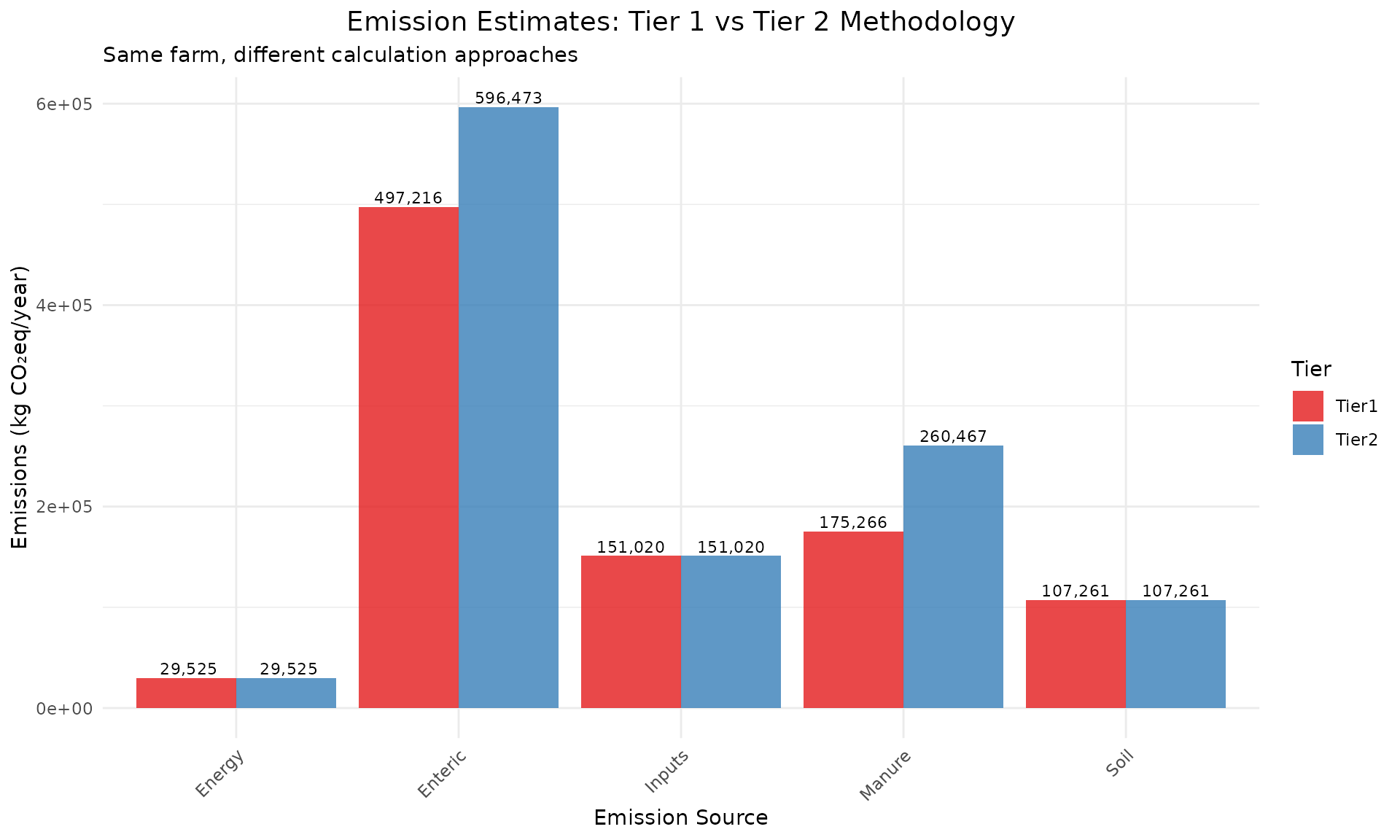
Impact on Intensity Metrics
# Calculate intensity metrics for both tiers
intensity_t1 <- calc_intensity_litre(
  total_emissions = total_t1,
  milk_litres = farm_profile$milk_production,
  fat = 3.7,
  protein = 3.2
)

intensity_t2 <- calc_intensity_litre(
  total_emissions = total_t2,
  milk_litres = farm_profile$milk_production,
  fat = 3.7,
  protein = 3.2
)

# Compare intensities
intensity_comparison <- data.frame(
  Metric = c(
    "Total Emissions (kg CO₂eq)", "Milk Intensity (kg CO₂eq/kg FPCM)",
    "FPCM Production (kg)", "Difference in Intensity (%)",
    "Management Classification"
  ),
  Tier1 = c(
    format(round(total_t1$total_co2eq), big.mark = ","),
    round(intensity_t1$intensity_co2eq_per_kg_fpcm, 3),
    format(round(intensity_t1$fpcm_production_kg), big.mark = ","),
    "-",
    ifelse(intensity_t1$intensity_co2eq_per_kg_fpcm < 1.2, "Good", "Needs Improvement")
  ),
  Tier2 = c(
    format(round(total_t2$total_co2eq), big.mark = ","),
    round(intensity_t2$intensity_co2eq_per_kg_fpcm, 3),
    format(round(intensity_t2$fpcm_production_kg), big.mark = ","),
    round((intensity_t2$intensity_co2eq_per_kg_fpcm - intensity_t1$intensity_co2eq_per_kg_fpcm) /
      intensity_t1$intensity_co2eq_per_kg_fpcm * 100, 1),
    ifelse(intensity_t2$intensity_co2eq_per_kg_fpcm < 1.2, "Good", "Needs Improvement")
  )
)

kable(intensity_comparison, caption = "Intensity Metrics: Tier 1 vs Tier 2")| Metric | Tier1 | Tier2 |
|---|---|---|
| Total Emissions (kg CO₂eq) | 960,288 | 1,144,746 |
| Milk Intensity (kg CO₂eq/kg FPCM) | 1.148 | 1.369 |
| FPCM Production (kg) | 836,400 | 836,400 |
| Difference in Intensity (%) | - | 19.2 |
| Management Classification | Good | Needs Improvement |
Accuracy and Uncertainty
Uncertainty Ranges by Tier
uncertainty_analysis <- data.frame(
  Source = c("Enteric", "Manure", "Soil", "Energy", "Inputs"),
  Tier1_Uncertainty = c("Higher", "Higher", "Higher", "Lower", "Medium"),
  Tier2_Uncertainty = c("Medium", "Medium", "Medium", "Lower", "Medium"),
  Key_Improvement = c(
    "Diet-specific Ym factors",
    "VS calculation from intake",
    "Site-specific soil factors",
    "No significant change",
    "Regional emission factors"
  )
)

kable(uncertainty_analysis, caption = "Uncertainty Comparison by Emission Source")| Source | Tier1_Uncertainty | Tier2_Uncertainty | Key_Improvement |
|---|---|---|---|
| Enteric | Higher | Medium | Diet-specific Ym factors |
| Manure | Higher | Medium | VS calculation from intake |
| Soil | Higher | Medium | Site-specific soil factors |
| Energy | Lower | Lower | No significant change |
| Inputs | Medium | Medium | Regional emission factors |
Factors Affecting Accuracy
# Create accuracy comparison visualization
accuracy_data <- data.frame(
  Factor = c(
    "Enteric - Default EF", "Enteric - Energy Method", "Manure - Default",
    "Manure - VS/MCF", "Soil - Standard", "Energy - Standard", "Inputs - Default"
  ),
  Tier = c("Tier 1", "Tier 2", "Tier 1", "Tier 2", "Both", "Both", "Both"),
  Uncertainty_Low = c(70, 85, 60, 75, 50, 85, 75),
  Uncertainty_High = c(130, 115, 140, 125, 150, 115, 125),
  Method_Complexity = c(1, 3, 1, 3, 2, 2, 2)
)

accuracy_data$Uncertainty_Mid <- (accuracy_data$Uncertainty_Low + accuracy_data$Uncertainty_High) / 2

ggplot(accuracy_data, aes(
  x = reorder(Factor, Method_Complexity),
  y = Uncertainty_Mid, color = Tier
)) +
  geom_pointrange(aes(ymin = Uncertainty_Low, ymax = Uncertainty_High),
    size = 0.8, alpha = 0.8
  ) +
  geom_hline(yintercept = 100, linetype = "dashed", color = "gray50") +
  coord_flip() +
  labs(
    title = "Accuracy Ranges by Methodology and Tier",
    subtitle = "100 = Perfect accuracy, wider ranges = higher uncertainty",
    x = "Calculation Method",
    y = "Accuracy Range (% of true value)",
    color = "IPCC Tier"
  ) +
  theme_minimal() +
  theme(plot.title = element_text(size = 14, hjust = 0.5)) +
  scale_color_brewer(type = "qual", palette = "Set1")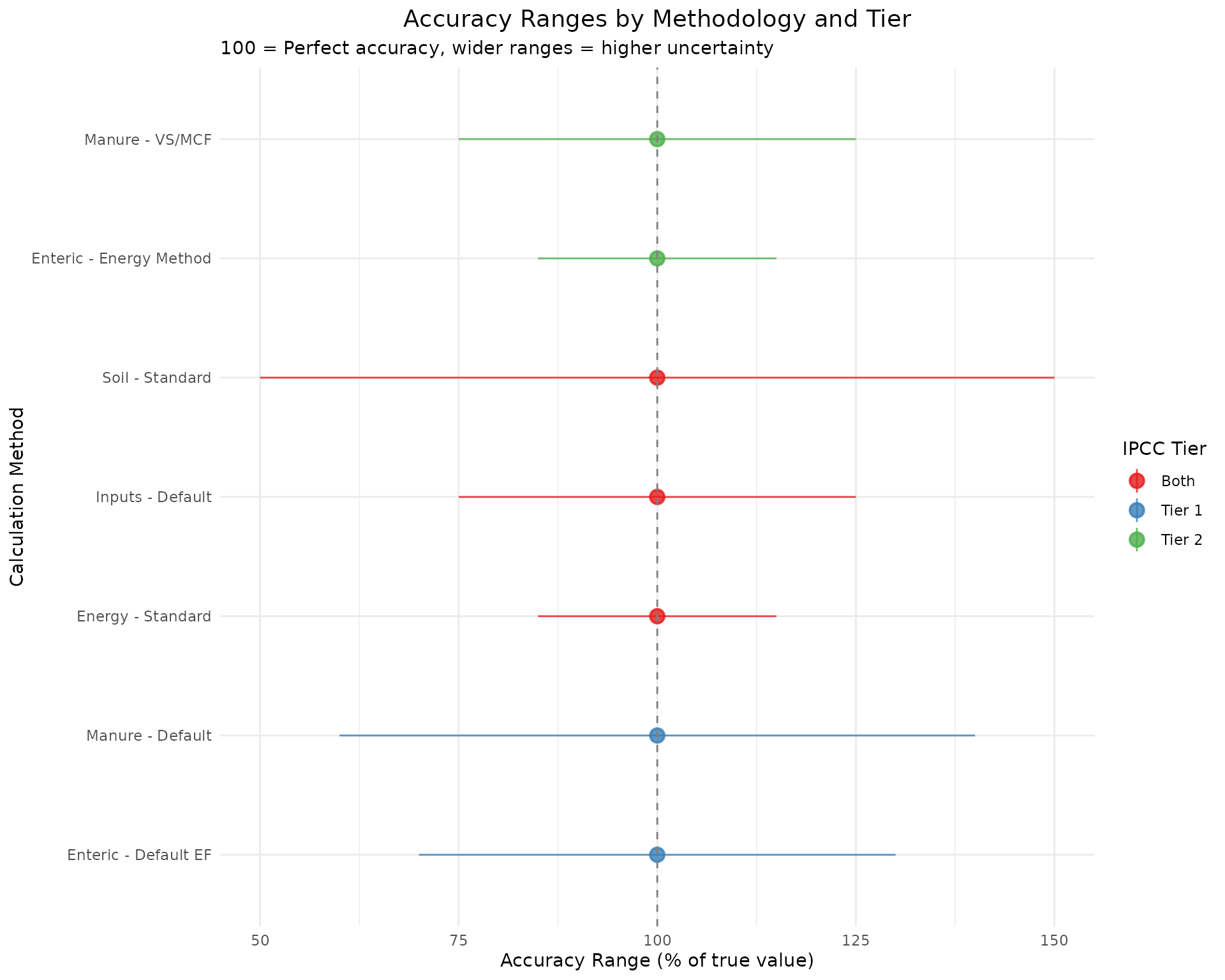
Decision Framework: When to Use Each Tier
Tier Selection Criteria
decision_framework <- data.frame(
  Criterion = c(
    "Purpose", "Data Availability", "Time Available", "Expertise Level",
    "Accuracy Needs", "Budget", "Follow-up Actions"
  ),
  Use_Tier1 = c(
    "Regional estimates, screening",
    "Basic farm records only",
    "< 1 day",
    "Basic agricultural knowledge",
    "Screening-level precision",
    "Minimal cost",
    "Awareness, general comparison"
  ),
  Use_Tier2 = c(
    "Farm management, mitigation",
    "Detailed records + measurements",
    "2-5 days",
    "Nutrition/LCA knowledge helpful",
    "Better precision when detailed inputs are available",
    "Moderate investment",
    "Specific interventions, monitoring"
  )
)

kable(decision_framework, caption = "Tier Selection Decision Framework")| Criterion | Use_Tier1 | Use_Tier2 |
|---|---|---|
| Purpose | Regional estimates, screening | Farm management, mitigation |
| Data Availability | Basic farm records only | Detailed records + measurements |
| Time Available | < 1 day | 2-5 days |
| Expertise Level | Basic agricultural knowledge | Nutrition/LCA knowledge helpful |
| Accuracy Needs | Screening-level precision | Better precision when detailed inputs are available |
| Budget | Minimal cost | Moderate investment |
| Follow-up Actions | Awareness, general comparison | Specific interventions, monitoring |
Cost-Benefit Analysis
# Cost-benefit comparison
cost_benefit <- data.frame(
  Aspect = c(
    "Data Collection Cost", "Technical Expertise", "Processing Time",
    "Result Accuracy", "Management Value", "Policy Applicability"
  ),
  Tier1_Score = c(1, 1, 1, 2, 2, 3), # 1=low, 3=high
  Tier2_Score = c(3, 2, 2, 3, 3, 2),
  Weight = c(0.2, 0.15, 0.15, 0.25, 0.15, 0.1) # Importance weights
)

cost_benefit$Tier1_Weighted <- cost_benefit$Tier1_Score * cost_benefit$Weight
cost_benefit$Tier2_Weighted <- cost_benefit$Tier2_Score * cost_benefit$Weight

tier1_total <- sum(cost_benefit$Tier1_Weighted)
tier2_total <- sum(cost_benefit$Tier2_Weighted)

cat("Weighted Decision Scores:\n")
#> Weighted Decision Scores:
cat("Tier 1:", round(tier1_total, 2), "\n")
#> Tier 1: 1.6
cat("Tier 2:", round(tier2_total, 2), "\n")
#> Tier 2: 2.6
cat(
  "\nRecommendation: Use", ifelse(tier2_total > tier1_total, "Tier 2", "Tier 1"),
  "for most farm-level assessments\n"
)
#>
#> Recommendation: Use Tier 2 for most farm-level assessments
Sensitivity Analysis
Parameter Sensitivity in Tier 2
# Test sensitivity of key Tier 2 parameters
sensitivity_tests <- list(
  baseline = list(ym = 6.1, body_weight = 580, dm_intake = 19.2),
  high_ym = list(ym = 6.8, body_weight = 580, dm_intake = 19.2),
  low_ym = list(ym = 5.4, body_weight = 580, dm_intake = 19.2),
  heavy_cows = list(ym = 6.1, body_weight = 650, dm_intake = 19.2),
  light_cows = list(ym = 6.1, body_weight = 510, dm_intake = 19.2),
  high_intake = list(ym = 6.1, body_weight = 580, dm_intake = 21.5),
  low_intake = list(ym = 6.1, body_weight = 580, dm_intake = 16.9)
)

sensitivity_results <- lapply(names(sensitivity_tests), function(scenario) {
  params <- sensitivity_tests[[scenario]]

  enteric_test <- calc_emissions_enteric(
    n_animals = farm_profile$dairy_cows,
    cattle_category = "dairy_cows",
    avg_milk_yield = farm_profile$milk_yield_per_cow,
    avg_body_weight = params$body_weight,
    dry_matter_intake = params$dm_intake,
    ym_percent = params$ym,
    tier = 2
  )

  data.frame(
    Scenario = scenario,
    CH4_kg = enteric_test$ch4_kg,
    CO2eq_kg = enteric_test$co2eq_kg
  )
})

sensitivity_df <- do.call(rbind, sensitivity_results) %>%
  mutate(
    Change_from_baseline = round((CO2eq_kg - CO2eq_kg[Scenario == "baseline"]) /
      CO2eq_kg[Scenario == "baseline"] * 100, 1)
  )

kable(sensitivity_df, caption = "Tier 2 Parameter Sensitivity Analysis")| Scenario | CH4_kg | CO2eq_kg | Change_from_baseline |
|---|---|---|---|
| baseline | 17007.34 | 462599.6 | 0.0 |
| high_ym | 18959.00 | 515684.8 | 11.5 |
| low_ym | 15055.68 | 409514.4 | -11.5 |
| heavy_cows | 17007.34 | 462599.6 | 0.0 |
| light_cows | 17007.34 | 462599.6 | 0.0 |
| high_intake | 19044.68 | 518015.2 | 12.0 |
| low_intake | 14970.00 | 407184.0 | -12.0 |
Impact on Farm Rankings
# Create hypothetical farm comparison
set.seed(456)
farm_comparison <- data.frame(
  Farm = paste0("Farm_", LETTERS[1:6]),
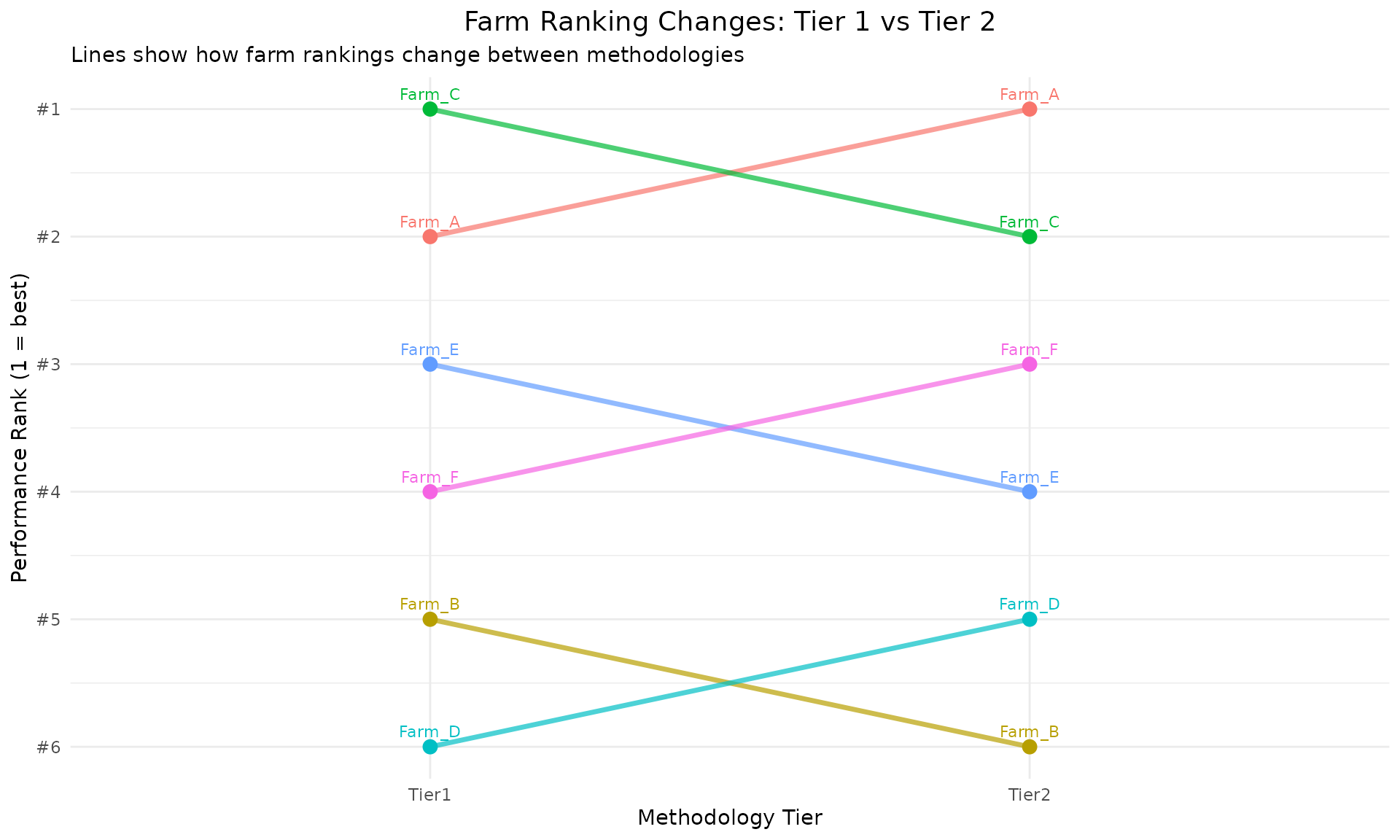
  Tier1_Intensity = c(1.15, 1.42, 0.98, 1.65, 1.28, 1.33),
  Tier2_Intensity = c(1.08, 1.51, 1.12, 1.48, 1.35, 1.29)
) %>%
  mutate(
    Tier1_Rank = rank(Tier1_Intensity),
    Tier2_Rank = rank(Tier2_Intensity),
    Rank_Change = Tier2_Rank - Tier1_Rank
  )

# Visualize ranking changes
ranking_plot_data <- farm_comparison %>%
  select(Farm, Tier1_Rank, Tier2_Rank) %>%
  tidyr::pivot_longer(
    cols = c(Tier1_Rank, Tier2_Rank),
    names_to = "Tier", values_to = "Rank"
  ) %>%
  mutate(Tier = gsub("_Rank", "", Tier))

ggplot(ranking_plot_data, aes(x = Tier, y = Rank, group = Farm, color = Farm)) +
  geom_line(size = 1.2, alpha = 0.7) +
  geom_point(size = 3) +
  geom_text(aes(label = Farm), vjust = -0.8, size = 3) +
  scale_y_reverse(breaks = 1:6, labels = paste0("#", 1:6)) +
  labs(
    title = "Farm Ranking Changes: Tier 1 vs Tier 2",
    subtitle = "Lines show how farm rankings change between methodologies",
    x = "Methodology Tier",
    y = "Performance Rank (1 = best)"
  ) +
  theme_minimal() +
  theme(
    legend.position = "none",
    plot.title = element_text(size = 14, hjust = 0.5)
  )
kable(farm_comparison[, c("Farm", "Tier1_Intensity", "Tier2_Intensity", "Rank_Change")],
  caption = "Impact of Methodology on Farm Rankings"
)| Farm | Tier1_Intensity | Tier2_Intensity | Rank_Change |
|---|---|---|---|
| Farm_A | 1.15 | 1.08 | -1 |
| Farm_B | 1.42 | 1.51 | 1 |
| Farm_C | 0.98 | 1.12 | 1 |
| Farm_D | 1.65 | 1.48 | -1 |
| Farm_E | 1.28 | 1.35 | 1 |
| Farm_F | 1.33 | 1.29 | -1 |
Practical Recommendations
Implementation Strategy
Based on the analysis, here are practical recommendations:
For Research and Policy
- Use Tier 2 for developing mitigation strategies
- Use Tier 1 for initial screening and regional inventories
- Combine approaches for cost-effective large-scale assessments
Quality Assurance
# Quality control recommendations
quality_control <- data.frame(
  Tier = c("Tier 1", "Tier 1", "Tier 2", "Tier 2", "Both"),
  Check_Type = c(
    "Data Range", "Internal Consistency", "Parameter Validation",
    "Results Plausibility", "Cross-Validation"
  ),
  Description = c(
    "Verify animal numbers and production within expected ranges",
    "Check milk per cow, stocking rates against system type",
    "Validate body weights, intakes against literature values",
    "Compare results with similar farms and published studies",
    "Run both tiers where possible, investigate large differences"
  ),
  Critical_Level = c("Medium", "High", "High", "Medium", "High")
)

kable(quality_control, caption = "Quality Assurance Recommendations by Tier")| Tier | Check_Type | Description | Critical_Level |
|---|---|---|---|
| Tier 1 | Data Range | Verify animal numbers and production within expected ranges | Medium |
| Tier 1 | Internal Consistency | Check milk per cow, stocking rates against system type | High |
| Tier 2 | Parameter Validation | Validate body weights, intakes against literature values | High |
| Tier 2 | Results Plausibility | Compare results with similar farms and published studies | Medium |
| Both | Cross-Validation | Run both tiers where possible, investigate large differences | High |
Conclusions
Key Findings
Tier differences: Tier 2 can differ from Tier 1 because it uses more farm-specific parameters (e.g., intake, body weight, digestibility, Ym). The magnitude and direction of the change depend on the farm system and the quality of the Tier 2 inputs.
Source-specific impacts: Enteric fermentation and manure management are often the most sensitive to tier choice, because Tier 2 relies on more detailed animal and diet information.
Data investment: Tier 2 typically requires more detailed data collection and more careful parameter checking, but it can provide results that are more representative of the specific farm when those inputs are reliable. ### Selection Guidelines
Choose Tier 1 when: - Conducting regional assessments with limited resources - Screening large numbers of farms quickly - Data availability is severely limited - Results are for general awareness or policy screening
Choose Tier 2 when: - Developing farm-specific mitigation strategies - Monitoring progress over time - Detailed data is available or can be collected - Results will guide significant investments
Use both when: - Resources allow for comprehensive analysis - Validation of results is critical - Training purposes or methodology development
The choice between Tier 1 and Tier 2 should align with the intended use of results, available resources, and required accuracy. cowfootR’s flexible implementation of both tiers enables users to select the most appropriate methodology for their specific needs.
This analysis demonstrates cowfootR’s implementation of IPCC 2019 guidelines. For detailed single-farm analysis, see the “Single Farm Analysis” vignette. For processing multiple farms, consult the “Batch Farm Assessment” vignette.